CoF Mitigation as Risk Reduction
Full read at Chapter 11
Guiding Equation
Leak impact (LI) = product hazard (PH) X leak (LQ) X dispersion (D) X receptors (R)
LI = PH × LQ × D × R
Where
LI = leak impact
LQ = leak quantity (quantity of the liquid or vapor release)
D = dispersion (spread or range of the leak)
R = receptors (anything that could be damaged
by contact with the release).
While no longer sufficient to fully quantify consequences in a modern risk assessment, this is a useful underlying equation to guide the analyses. Since each variable is multiplied by all others, each can independently and radically impact the final consequence.
Note that the first three impact hazard zone size while the fourth addresses potential damages within the hazard zone. This reflects the overall CoF measurement process–identify the area in which consequences are possible and then examine potential damages within that area.
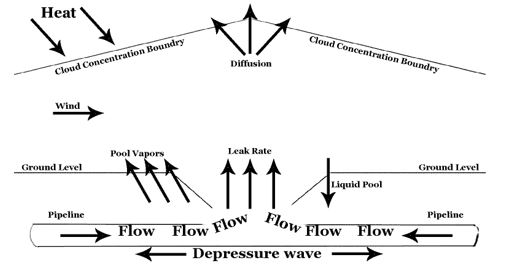
- Spill Size
- Dispersion
- Receptors
- Product Hazard
- Receptors
- VSL
- Clean up costs
- Product Hazard
- CERCLA
- Toxicity
- Flammability

- Spill Size
- Gas release modeling
- spill footprints
- leak detection
- liquid drain down
- hole size


CoF Mitigation
The first determination for the risk implications of a mitigation measure is whether it plays a role mostly in terms of failure avoidance or consequence minimization. For example, it can be argued that leak detection should be assessed only in the consequence analyses because it acts as a consequence-limiting activity—the leak has already occurred and early detection can reduce the potential consequences of the leak. However, leak detection can also play a role in leak frequency—sometimes allowing intervention before an ‘actionable’ leak manifests, either as a larger hole develops or the leak continues for a sufficient period of time to change the probability of a higher consequence scenario occurring.
Definition of ‘Failure’ Impacts PoF
Depending on the definition of ‘failure’, the scenario described above may reduce failure probability in addition to consequence potential.
Distribution systems are a good example of this nuance. Distribution systems tend to have a higher incidence of leaks compared to transmission systems. This is partly due to differences in the age, materials, construction techniques, and operating environment between the two types of pipelines.
It is also due to definitions of ‘failure’. Leakage in some low pressure distribution systems is more routine and leak detection and repair is a normal aspect of operations. Some leaks are not actionable except for perhaps inclusion on a ‘monitoring’ list. Before some threshold leak rate (or leak circumstance) is reached, the leak is not a ‘failure’. Furthermore, leaks often provide early warning of deteriorating system integrity. The number of leak locations is often used as a forecaster of ‘failures’, with failure being a leak of actionable size. Therefore, there may be overlap where a mitigation measure such as leak detection plays a role in both PoF and CoF estimations. This is not an obstacle for the risk assessment approach recommended here—any and all measures reducing either can be readily included in the assessment.
When a measure such as leak detection is thought to play a significant role in failure rates—by some definition of ‘failure’–it is readily incorporated into the exposure, mitigation, and resistance modeling of PoF. It will often be best modeled as an inspection, playing a similar role as other inspections such as ILI. It first provides some indications of resistance—where damage has already occurred. It then provides inferential evidence of both exposure—failure rates may be higher when the leak suggest system deterioration—and mitigation—the leak, having occurred despite mitigation, informs the assessment of mitigation effectiveness.

Most mitigations discussed here will only impact CoF. Assessing CoF mitigation means measuring (quantifying) and including in the risk assessment, the ability to reliably minimize the area of exposure or exposure time.
In other words, the assessor accounts for the abilities of the mitigation measures to reduce the hazard zone itself or to minimize damages to receptors within the hazard zone. Specifically, this involves the quantification of one or more of the following aspects;
- Reduction in spill/release volume
- Reduction is release dispersion
- Fewer receptors harmed
- Less harm to exposed receptors
Especially for the first two, the quantification can be based on robust calculations.
See detailed discussions of common CoF mitigation measures.
Full read at Chapter 11 CoF–Mitigation